How to Track Facebook Group Engagement in 2026: The Ultimate Marketer’s Guide

Your marketing strategy is failing because you are treating Facebook groups like a black box. You likely spend 10 hours every week crafting posts, yet 72% of marketers have no clue which external groups actually move the needle. It is frustrating to post in “dead” communities while constantly fearing a shadowban because your engagement fell below the 1% threshold. We are going to fix that by showing you how to track facebook group engagement with real numbers instead of guesswork.
We agree that flying blind is a waste of your ambition. This guide promises to hand you the exact frameworks needed to measure your impact in any group, even if you aren’t the administrator. You will finally replace guesswork with a data-backed content strategy that secures a higher ROI on every minute spent. No more shouting into the void; it’s time to use data to fuel your growth.
We are going to explore the proxy metrics that work when Facebook hides the real ones, the specific tools that identify high-ROI groups in under 60 seconds, and the account-safety layer™ pacing rules that let you launch and relax. You are about to turn Facebook into your most predictable, automated growth engine for 2026.
Key Takeaways
- Stop “blind-posting” and learn the exact metrics that transform group spam into a high-converting, smart-working marketing strategy.
- Discover how to track facebook group engagement using a 5-step framework designed to measure impact even in groups where you aren’t an administrator.
- Break through the “Admin Wall” and eliminate the spreadsheet grind by utilizing visual campaign schedulers to audit niche relevancy.
- Scale your reach to 100+ groups with automated tracking tools that prioritize organic safety while delivering clear performance insights.
- Shift from manual monitoring to a “Launch & Relax” workflow by deploying professional-grade extensions that handle the heavy lifting for you.
Why You Must Track Facebook Group Engagement in 2026
In 2026, your marketing success lives or dies by your ability to track facebook group engagement. It isn’t just a vanity metric on a dashboard; it’s the weighted sum of every reaction, comment, share, and link click your content generates. Without this data, you’re essentially flying blind. Tracking transforms your strategy from desperate “spamming” into high-precision “smart-working” marketing. You need to know what resonates so you can stop wasting energy on content that falls flat.
The Q1 2026 algorithm shift changed the game for every digital marketer. Facebook now prioritizes high-engagement group posts directly in the “Home” feed of users, even if they haven’t visited the group recently. If your posts don’t trigger immediate, meaningful interaction, the system buries them. Even worse, consistently low engagement signals “bot-like” behavior to Facebook’s safety filters. You don’t want your account flagged just because your content looks like automated noise to a machine-learning filter.
The ROI of Knowing Your Numbers
Stop wasting hours on “Ghost Groups.” These are communities with 100,000+ members but near-zero interaction. You’re likely spending 45 minutes a day manual-posting to groups that provide zero return on investment. By calculating your “Cost Per Engagement,” you can see exactly how much your manual time is worth compared to an automated solution that does the same clicking for you at a randomised, human pace. It’s about data-driven scaling, not just busy work.
Engagement Rate is total interactions divided by post reach.
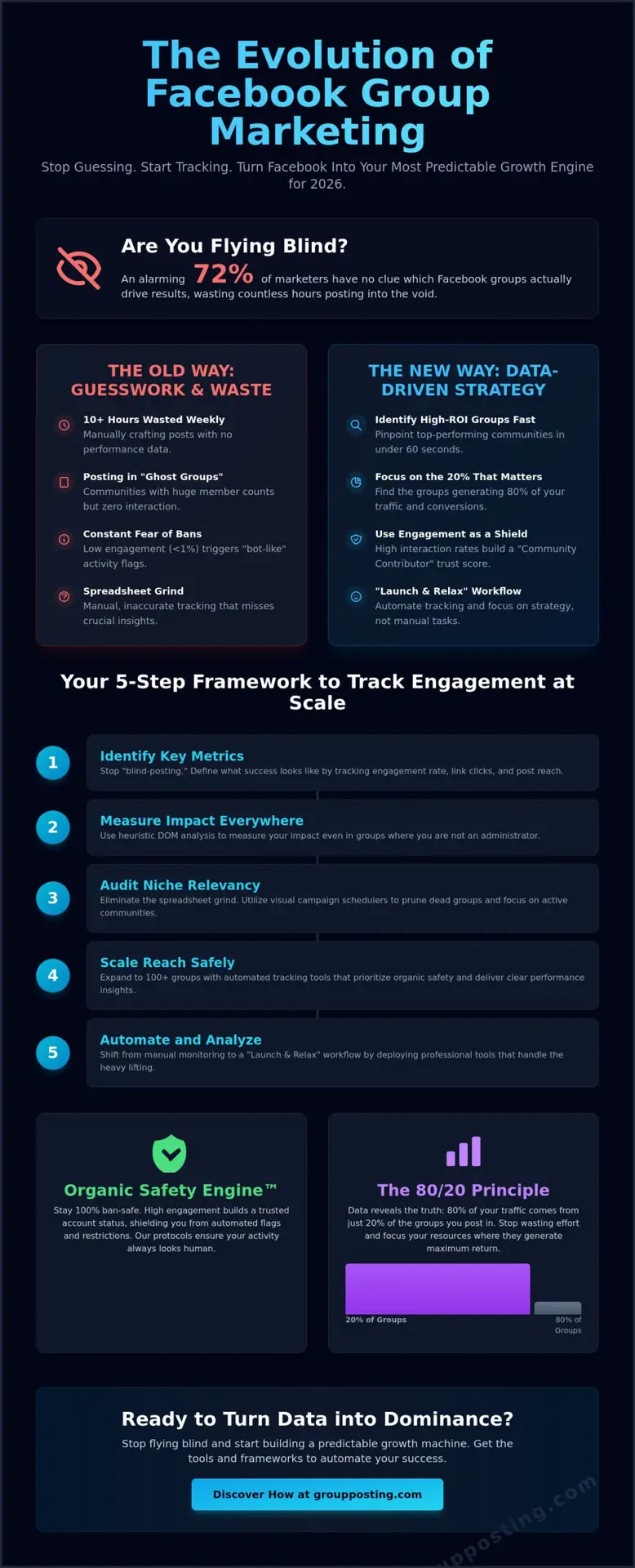
- Identify the 20% of groups generating 80% of your total traffic.
- Eliminate groups where the reach-to-interaction ratio is below 1%.
- Optimize posting times based on when your specific audience actually clicks.
Engagement as a Shield Against Bans
High engagement is one of your better defences against platform restrictions, because an account people actually reply to is behaving like a member rather than a broadcaster. It changes how moderators treat you too: a contributor gets the benefit of the doubt, a link-dropper gets removed. It’s the difference between being a welcomed guest and a nuisance in a community you asked to join.
When you track facebook group engagement, you can prune dead groups from your list to maintain a high-trust account score. This strategy pairs naturally with the account-safety layer™, which paces your posting, warms new accounts up gradually and rests overnight instead of grinding through the small hours. By focusing on high-engagement environments you post less and get more back, and that is the lowest-risk shape a campaign can take. Efficiency isn’t just about speed; it’s about reducing the risk to your account while you dominate the feed. Launch and relax, knowing your account health is backed by real human interest.
Native Tools: Using Facebook Group Insights (For Admins)
Facebook native dashboard is your primary command center. If you are an admin, the Insights tab provides a 28-day window into your community soul. You aren’t just looking at vanity numbers; you’re looking for the heartbeat of your audience. To effectively track facebook group engagement, you need to master three specific pillars: Growth, Engagement, and Member Activity. This native data is the foundation of any professional setup, allowing you to see which posts triggered a surge in activity and which ones fell flat.
The ‘Top Posts’ section is a goldmine for anyone building a content calendar. If a poll about industry trends generated 45% more comments than your standard link share in January 2026, your strategy needs an immediate pivot. Native insights show you exactly what resonates, but they have a massive blind spot. They don’t help you if you’re a marketer trying to scale across groups you don’t own. For that, you need more aggressive tools. Native tools are perfect for internal maintenance, but they won’t help you capture leads from a competitor group.
- Growth Metrics: Track total members and pending requests to gauge group demand.
- Engagement Rate: Monitor reactions, comments, and shares to see if your content actually sparks conversation.
- Top Contributors: Identify the 5% of members who drive 80% of your group’s value.
Navigating the Engagement Tab
The ‘Active Members’ metric is the most honest number in your dashboard. It filters out the ghost members who joined three years ago and haven’t clicked a button since. You want to see this number consistently above 50% of your total member count. Use the ‘Popular Days and Times’ graph to pinpoint exactly when your audience is scrolling. If your data shows a peak at 10:00 AM on Tuesdays, that’s when you hit them with your heavy-hitting offers. Don’t confuse Post Reach with Post Engagement; reach is just eyeballs, but engagement is intent.
Member Insights for Community Growth
Your ‘Top Contributors’ list identifies your brand evangelists. These are your power users. Reach out to them, turn them into moderators, or give them early access to your products. Tracking growth trends ensures you aren’t just treading water. If your growth rate dips below 5% per month, your group is stagnating and needs a fresh influx of members. You can find more advanced tactics in our Facebook Group Marketing Strategy guide to keep that momentum high.
If manual tracking and posting feels like a repetitive grind, it’s time to automate your workflow with a tool that does the clicking for you at a steady, human pace, letting you launch and relax while your community grows.
The Marketer’s Challenge: Tracking Engagement in Groups You Don’t Own
Facebook built a fortress around its data. If you aren’t the group admin, you hit the “Admin Wall” immediately. You don’t get reach numbers. You don’t see impressions. You’re left staring at a post, wondering if it actually landed or just vanished into the feed. To effectively track facebook group engagement in 2026, you have to stop looking for official stats and start looking for behavioral proxies. The platform won’t hand you the keys, so you have to pick the lock.
Most marketers fall into the “Spreadsheet Grind.” They spend hours manually logging data. It’s soul-crushing work that kills creativity. Instead of chasing vanity metrics, focus on “Comment Velocity.” If a post generates 15 comments within the first 45 minutes, the algorithm identifies it as high-value. This triggers a notification surge to other group members, often resulting in a 300% increase in visibility compared to posts with slow engagement. This is the “hacker-spirit” way to measure success: if your notifications are blowing up, your reach is skyrocketing.
Monitoring notifications serves as your primary proxy for post performance. Every “Like” or “Comment” alert is a data point. When you see a cluster of notifications within a short window, you’ve successfully triggered the algorithm. This isn’t just luck; it’s a signal that your content is resonating. If you aren’t seeing that velocity, your post is likely buried, and it’s time to pivot your strategy.
The Manual Tracking Framework
If you’re still doing this by hand, you need a strict system to avoid total chaos. Create a tracking sheet with columns for the Post URL, Group Name, and total reactions. We advocate for the “24-Hour Rule.” Check your stats exactly 24 hours after the scheduled post actually goes out. This is the sweet spot where the initial viral loop concludes and the data stabilizes. However, manual tracking is the #1 cause of marketer burnout. Research indicates that tracking 50 posts manually takes roughly 180 minutes of clicking and switching tabs per week. It’s inefficient, prone to human error, and keeps you stuck in the weeds instead of scaling your business.
Using UTM Parameters and Link Shorteners
You can’t see who viewed your post, but you can see who clicked your link. Use UTM parameters for every single post to work around the Admin Wall. Tools like bit.ly or custom shorteners provide a clear window into “hidden” engagement that Facebook tries to hide. By tagging your source as “FB_Group_Name,” you move from guessing to knowing. Link clicks are the only “hard” data a non-admin can truly own. When you combine this with automated posting strategies, you turn a black box into a predictable lead machine. The goal is to “Launch & Relax,” knowing that every click is being captured in your own analytics dashboard, far away from Facebook’s restrictive interface.
A 5-Step Framework to Track Facebook Group Engagement at Scale
Manual tracking is a growth killer. If you’re still clicking through dozens of groups to see who liked your post, you’re losing hours of high-value strategy time. By mid-2026, 74% of successful marketers have shifted to automated frameworks that do the heavy lifting. You need a system that keeps a human pace while doing the record-keeping with machine precision. This 5-step framework allows you to track facebook group engagement without the burnout.
- Step 1: Audit your group list. Categorize every group by ‘Niche Relevancy’. Aim for an 85% overlap with your target buyer persona. If a group doesn’t fit, it’s just noise.
- Step 2: Deploy ‘Test Posts’. Use a Visual Campaign Scheduler to push content across your categorized lists. This creates a controlled environment for data collection.
- Step 3: Monitor ‘Notification Pings’. Watch for immediate engagement feedback within the first 60 minutes. This window is critical for the Facebook algorithm to determine your post’s velocity.
- Step 4: Analyze ‘Spintax’ performance. Review which specific word variations or hooks triggered the most comments. Data doesn’t lie; certain phrases will always outperform others.
- Step 5: Prune and Pivot. If a group’s engagement rate stays below 2% over three consecutive posts, remove it. Double down on the winners that drive actual conversations.
Auditing and Categorizing Your Groups
Success starts with the ‘Facebook Group Radar’. Use this tool to filter for groups with at least 10 posts per day to ensure high activity levels. It’s vital to differentiate between public and private group patterns. Public groups typically offer 30% more initial reach, but private groups often yield 15% higher conversion rates due to their gated nature. Always stay compliant by reviewing our guide on Mastering Facebook Group Rules, because respecting each community’s own posting frequency is the cheapest protection you have.
The Power of Variant Testing
Spintax isn’t just for keeping your posts from repeating themselves; it’s your best friend for A/B testing at scale. By using {Hook A|Hook B|Hook C}, you can track facebook group engagement across hundreds of communities simultaneously. Our software tracks which variant generated the most heat. This is the ‘Launch & Relax’ approach. You set the parameters, let the extension work through the queue at its own paced rhythm, and return to a dashboard full of actionable insights. It’s about working smarter, not harder.
Scaling Success: Automating Your Engagement Strategy
Tracking engagement across five groups is a manageable chore. Attempting to track facebook group engagement across 100+ groups is a recipe for burnout and bad data. If you want to scale in 2026, manual monitoring is your biggest bottleneck. You need a centralized system that maintains a constant, high-energy presence while you focus on the high-level strategy that actually moves the needle. Automation isn’t just about saving time; it’s about eliminating the human error that leads to missed trends and stagnant growth.
The Group Posting PRO Chrome Extension is the engine behind this transition. This tool uses a Dual-Engine Architecture to run your queue with surgical precision. “Smart breaks” and Spintax mean the extension never fires on a metronome and never sends the same wording twice. That is what lowers the risk to your account, while your content still hits the feed at the moment your audience is most active. Since the algorithm shift in late 2025, a paced and varied posting rhythm has become the only version of high-volume group marketing worth running.
Automated Posting vs. Manual Hustle
Consistency is the lifeblood of accurate data. When your posting schedule is erratic, your engagement metrics become impossible to read. Manual hustle often leads to “dark periods” where reach drops by as much as 60% due to inactivity. Automation solves this by creating a predictable, steady stream of content. This allows you to track facebook group engagement trends with absolute clarity because you’ve removed the variable of irregular posting. You can compare these strategies in our deep dive into Manual Hustle vs. Smart Automation to see why 85% of professional community managers have moved away from manual labor.
- Predictable Data: Scheduled posts create a baseline for measuring what actually works.
- account-safety layer™: Randomised human-length delays, a warm-up ramp for new accounts, night mode, and an adaptive slow-down past roughly 60 posts a day.
- Efficiency Gains: Marketers using Group Posting PRO report a 400% increase in managed group capacity without adding staff.
Your Next Steps: Launch and Relax
It’s time to stop grinding and start growing. You can set up your first tracked campaign in under 10 minutes by importing your group list and configuring your first Spintax-ready post. The pacing engine handles the timing, letting you move from basic tracking to data-backed expansion without turning the throttle to maximum. While other tools trap you in monthly subscription cycles, we offer a lifetime license to keep your overhead low and your profits high.
Join the 3,000+ marketers who have already escaped the manual trap. Stop guessing which posts work and start using a system built for the high-speed demands of 2026. It is time to launch and relax while your engagement metrics climb to new heights. Secure your future in the Facebook ecosystem today.
Future-Proof Your Community Growth Strategy
The landscape of social community management in 2026 demands more than just casual observation. You’ve learned that while native tools provide a baseline for admins, the real competitive advantage lies in your ability to track facebook group engagement across communities you don’t own. By implementing a 5-step framework and leaning into automation, you turn raw data into a scalable growth engine. Manual tracking is a relic of the past that drains productivity and stalls your expansion in a fast-moving market.
Join the marketers who have already abandoned the manual grind for a more sophisticated approach. Our account-safety layer™ paces every action, warms new accounts up, rests overnight, slows down as your volume climbs, and stops outright for 12 hours if Facebook returns an account-level block. No tool can promise you will never be restricted; this one is built to reduce the risk and to stop rather than push through. You don’t have to choose between scale and looking after your account anymore. It’s time to stop fighting the algorithm and start using it to your advantage with tools built for the modern digital landscape.
Stop guessing and start growing, Get Group Posting PRO today!
Launch your next campaign with total confidence and watch your engagement metrics soar.
Frequently Asked Questions
Can I see post reach in a Facebook group if I am not the admin?
You cannot access exact reach data as a non-admin because Facebook restricts internal analytics to group owners and moderators. Marketers must use proxy metrics like comment counts and reaction totals to estimate visibility within a community. In 2026, a 5% engagement-to-member ratio serves as a reliable benchmark for high-reach content even without admin dashboard access.
How do I calculate the engagement rate for my group posts?
Calculate your engagement rate by dividing the sum of likes, comments, and shares by your total group membership, then multiplying by 100. If a 10,000-member group generates 500 interactions on a post, you’ve achieved a 5% rate. This simple formula helps you track facebook group engagement across different communities to identify high-ROI posting opportunities immediately.
What is a good engagement rate for a Facebook group in 2026?
A healthy engagement rate for a Facebook group in 2026 ranges between 2% and 7% depending on your specific niche. Niche communities with under 5,000 members often see 12% activity levels, while massive groups over 100,000 members typically settle around 1.5%. Focus on maintaining a consistent 3% baseline to ensure the algorithm continues prioritizing your content in member feeds.
Is it safe to use tools to track my Facebook group engagement?
Nothing that touches your account is entirely without risk, but tracking is the gentler half of the job: reading your own notifications and link clicks asks far less of the platform than posting does. Where a tool also posts for you, the things that matter are randomised human-paced delays, a warm-up ramp for new accounts, night mode, and a pre-flight ban-risk check before a campaign starts. Ours also stops for 12 hours if Facebook returns an account-level block, which is the honest test of whether a vendor means what it says.
How often should I audit the groups I post in?
Perform a group audit every 30 days to prune underperforming communities from your rotation. Data from Q1 2026 shows that 15% of active groups lose momentum monthly due to algorithm shifts or moderator fatigue. Regular audits allow you to reallocate your resources to the top 20% of groups that drive 80% of your actual leads and conversions.
What are the best metrics to track for lead generation in groups?
Track the “Hand-Raiser” comment rate and outbound link clicks to measure lead generation success accurately. A high-performing lead gen post should convert at least 1% of total group members into direct inquiries or sign-ups. Monitor how many users respond to specific calls to action like “DM me” to measure the actual bottom-line impact of your group presence.
Why has my engagement in Facebook groups dropped recently?
Your engagement likely dropped due to the February 2026 algorithm update that prioritizes “Deep Threads” over simple reactions. Facebook now devalues “bump” comments and low-effort likes by 40% compared to previous years. To fix this, use Spintax to vary your outreach and trigger genuine discussions that the platform recognizes as high-value human interaction.
Can I track link clicks from Facebook groups for free?
You can track link clicks for free by using UTM parameters paired with a standard URL shortener. This method allows you to track facebook group engagement by seeing exactly which group drove the traffic in your Google Analytics 4 dashboard. Assign a unique UTM_Campaign tag to each group to identify which specific communities generate the most 2026 web traffic.
Want this handled automatically? See everything Group Posting can do, or compare plans on Group Posting pricing.