Real Estate Facebook Posts: 12 Group Post Examples to Adapt
- Lead generation
- Local marketing

Useful real estate Facebook group posts answer a specific property question, offer a relevant resource or describe an authorized opportunity with a clear next step. The twelve examples below are adaptable drafts for buyers, sellers, renters and property investors. They are not real customer stories, verified listings or claims of proven conversion.
Start with the group's rules and an actual need you can serve. Keep property facts current, disclose your business role and invite a response without asking members to publish financial or personal details in the thread. A resource request is a conversation opening; it is not yet an appointment or a qualified lead.
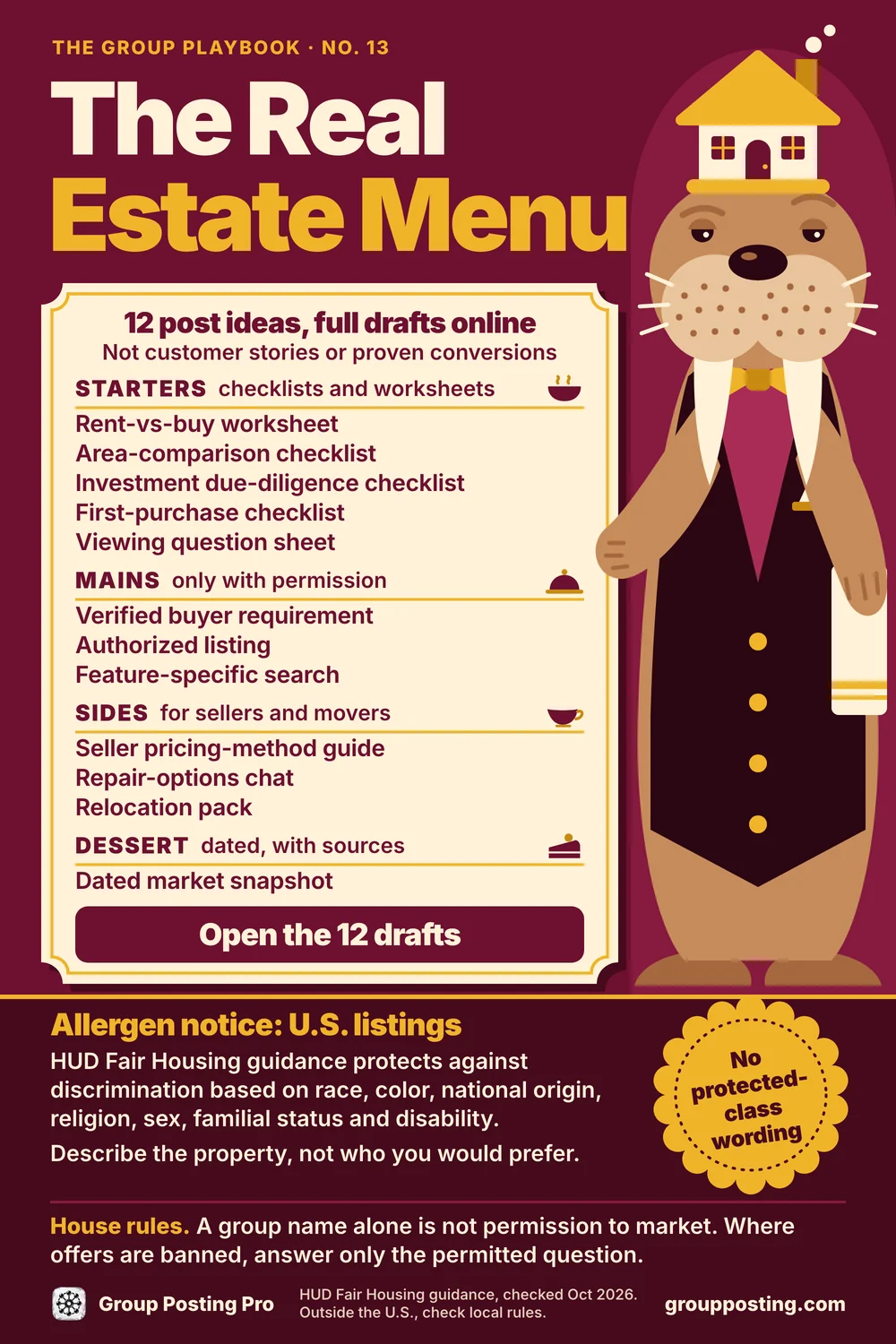
Read this sheet as text
12 post ideas, full drafts online. Not customer stories or proven conversions.
Starters: checklists and worksheets
- Rent-vs-buy worksheet
- Area-comparison checklist
- Investment due-diligence checklist
- First-purchase checklist
- Viewing question sheet
Mains: only with permission
- Verified buyer requirement
- Authorized listing
- Feature-specific search
Sides: for sellers and movers
- Seller pricing-method guide
- Repair-options chat
- Relocation pack
Dessert: dated, with sources
- Dated market snapshot
Allergen notice: U.S. listings
- HUD Fair Housing guidance protects against discrimination based on race, color, national origin, religion, sex, familial status and disability.
- Describe the property, not who you would prefer.
House rules. A group name alone is not permission to market. Where offers are banned, answer only the permitted question.
HUD Fair Housing guidance, checked Oct 2026. Outside the U.S., check local rules.
Real estate Facebook posts: use objective property criteria and check the applicable rules
For U.S. housing-related advertising, HUD's Fair Housing Rights and Obligations guidance identifies protection against discrimination based on race, color, national origin, religion, sex, familial status and disability. Describe the dwelling, price, location and verified features rather than the type of person you would prefer to occupy it. Apply consistent service and information standards.
Review your brokerage's advertising requirements, seller authorization, listing or MLS rules and relevant local housing rules before publishing. Group-admin permission is a separate requirement and does not settle those obligations. Outside the U.S., check the applicable local requirements rather than treating this U.S. source as universal guidance.
For neighborhood comparisons, provide objective sources such as travel routes, zoning, published fees and official district information. Let people choose their own criteria. Avoid demographic judgments, suggestions about who “belongs” in an area or unsupported labels about neighborhood suitability.
| Check | Evidence to keep |
|---|---|
| Accuracy | Current listing status, price, source date and permission to use the photos. |
| Representation | Your role, brokerage disclosures and permission to describe a client's requirement. |
| Housing fairness | Objective property language and consistently offered information. |
| Destination | Promotion rules, approved identity, permitted links and approval requirements. |
| Follow-up | The real resource, who answers and the next step the reader requested. |
12 adaptable real estate group post examples
Replace the bracketed fields with verified details. Remove any claim you cannot support. The explanations describe each draft's purpose, not measured results.
1. A verified buyer requirement
“With my buyer's permission, I'm looking for a property in [search area] with [objective features] within [verified budget]. If you represent a suitable property, please send the listing details through [contact route]. I'm [name and brokerage].”
Use only when you actually represent that requirement and have permission to share it. Do not invent a ready buyer to manufacture urgency. Keep personal identity and financial documents out of the group. Check listing and cooperation rules before using off-market language.
2. A seller pricing-method resource
“Thinking about how to price a property in [area]? I've made a short guide to the information used in a comparative market review: recent comparable sales, condition and competing listings. Would the guide be useful?”
Offer a resource you can supply. For a later estimate, explain its data date, method and uncertainty. Do not imply a guaranteed sale price or ask for an exact address in a public comment.
3. A renter-to-owner cost worksheet
“Comparing renting with buying? I have a worksheet for listing the costs on both sides, including upfront expenses, recurring costs and maintenance. I can share it, along with official homebuyer resources, if you'd like.”
Keep this educational; do not claim buying is always cheaper or suggest a mortgage approval outcome. The CFPB's homebuyer resources provide a useful official starting point, and its loan-choice guide encourages comparing lenders and understanding options. Refer financing questions to an appropriately qualified professional.
4. An objective area-comparison checklist
“Comparing properties in [areas]? My checklist includes travel routes, published association fees, planning information and questions to ask during a viewing. Which property detail would help you make a comparison?”
Provide sources and let readers set priorities. Avoid steering language about resident demographics or subjective neighborhood “fit.” If a person asks about schools, point to official district information and their chosen criteria rather than assigning them an area.
5. A property-investment due-diligence checklist
“Reviewing a small multifamily property? Before comparing asking prices, I check the documented income, expenses, occupancy information and permitted use. I have a question list for your own professional review if helpful.”
This invites a concrete discussion without making a return forecast. Explain what you can verify and which questions need legal, tax, lending or building expertise. Do not describe an investment as certain to be profitable.
6. A first-purchase process checklist
“I put together a first-home-purchase checklist covering preparation, loan comparison, inspections and closing questions. If you're exploring the process, I can send the resource. There's no need to share your income or documents here.”
A checklist request may come from someone researching months ahead. Ask what part of the process they want help understanding before proposing an appointment. Include official sources alongside your own local process notes.
7. A dated local market snapshot
“I've summarized [named source]'s property data for [area and period], including the definitions behind the figures. The report separates completed sales from active asking prices. Would the source-linked summary help?”
Use real data you are authorized to publish. State the period, geography, sample and any important exclusions. Do not fill the draft with invented price movements or imply that a broad average predicts one property's price.
8. A seller repair-options conversation
“Considering selling a property that needs repairs? I can help outline questions to compare selling in its current condition with obtaining estimates first. The options depend on the property, your timeline and the costs you verify.”
Help the owner examine choices without promising a quick sale or a particular net amount. Avoid soliciting sensitive distress details publicly. Clarify your representation and any referral relationship before connecting another service provider.
9. A relocation research pack
“Moving to [city]? I can share a research pack with public transport links, planning resources and a property-viewing checklist. Tell me which practical information you need, and I'll point you to the relevant source.”
Let the person define their property requirements and travel needs. Provide the same information standard to everyone. Replace broad “best neighborhood” recommendations with sourced comparisons based on the person's own objective criteria.
10. An authorized listing invitation
“With the owner's authorization, here are the current details for [property]: [verified features], [current price] and [viewing route]. Information checked on [date]. Full listing and required disclosures: [permitted link].”
This is a direct commercial post for a group that permits listings. Verify status before each submission and promptly update separate copies when details change. State property characteristics rather than preferred occupants.
11. A process example without an invented testimonial
“One useful viewing habit is to record questions before the visit: known repairs, included fixtures, fees and the documents available for review. Here's the question sheet I use when organizing a viewing.”
Show your process without inventing a recent client victory. If you later use an actual case or testimonial, obtain permission, protect private information and support the described facts. Do not turn a past result into a promise for the next person.
12. A feature-specific property search
“Would a source-linked list of currently available properties with [objective feature] in [area] be useful? I can explain what the listings state and which details need confirmation during a viewing.”
Choose verifiable features such as a ground-floor entrance, a workspace or published parking details. Do not label homes for a preferred demographic group. Confirm availability and obtain the required permission before distributing listing information.
Match the draft to the group's purpose
| Group context | Possible useful contribution | What to check |
|---|---|---|
| Homebuying questions | Process checklist or cost worksheet | Link rules; whether professional offers are permitted |
| Property listings | Authorized, current listing details | Required disclosures, format and approval |
| Local discussion | Public-source research pack or useful answer | Whether any commercial participation is allowed |
| Property investment | Due-diligence questions and source definitions | Professional scope and factual support |
Localize the facts and usefulness, not the demographic audience. A group name alone does not establish permission to market there. For a group that prohibits offers, answer only the permitted question or choose another destination.
Follow up with permission and one useful next step
When someone asks for a resource, acknowledge the request and explain how you can supply it. If a private conversation is appropriate, ask permission: “Would you prefer the resource here or by message?” Do not treat a comment as consent to unrelated sales messages or add the person to a marketing list automatically.
Illustrative follow-up: “Here is the checklist you requested. Which stage are you researching: preparation, viewing or comparing offers?” If the person wants help with a specific property, agree on a suitable private contact route before collecting the details. Keep financial documents and identity information out of group threads.
Record the resource requested, response sent, permission for further contact, stated property need and agreed next step. A like is engagement; a request is interest; a scheduled appointment is a different outcome. Do not combine them into a single lead count.
Measure useful conversations and maintain your copies
Keep the group, post link, draft version, source date and actual follow-up outcome together. Compare whether readers request the resource, ask a relevant property question or agree to a next step. Small samples can suggest an editorial improvement, but they do not establish that a template causes sales.
Use UTM parameters for permitted website links, and record direct messages separately. A website visit cannot account for every group conversation. The outreach guide covers a broader follow-up process.
Group Posting can organize reviewed destinations and drafts. Direct API uses internal Facebook web GraphQL requests; Classic DOM uses the visible composer in the existing logged-in browser. Scheduling requires an awake, online computer with Chrome open, the extension enabled and Facebook signed in. Permissions, format support and approval apply; pending submissions are not published results.
If you use Lead Radar, it checks periodically while the required browser is available and may miss relevant conversations. Inspect the actual post before responding. It does not replace permission, housing review or a human judgment about whether your answer is helpful. See the current monitoring workflow.
Source check, 3 October 2026: the CFPB resources were readable. HUD's current rights page was available through official indexed text while direct retrieval returned an incomplete shell. Its archived 2024 digital-platform guidance is dated background, not a claim that a sample post has received legal review.
Frequently asked questions
Are these real estate posts proven to generate leads?
No. They are illustrative drafts for different property questions and resources. Adapt them with verified facts and measure actual conversations and agreed next steps.
Can I copy the same listing into every local group?
Check each group's rules, your authorization, current listing facts and applicable advertising requirements. A separate copy needs its own maintenance when details change.
How should I describe who a property is suitable for?
Describe objective property features and provide consistently offered information. Avoid preferred-occupant language or demographic judgments; review the applicable fair housing and local advertising requirements.
Should I ask people to comment their budget or address?
Keep personal and financial details out of public threads. Start with the resource or question they requested, then agree on an appropriate private contact route if more detail is needed.
Explore the complete guide: Facebook group marketing.
For the group-publishing part of your workflow, explore the current Group Posting features, or compare plans on Group Posting pricing.