Facebook Groups Holiday Marketing Plan: A 9-Week Calendar
- Facebook groups
- Seasonal marketing
- Content calendar

To use Facebook groups for the 2026 holidays, start now and work in five phases: prepare (2–15 November), announce (16–22 November), peak (23 November–6 December), gift deadlines (7–20 December) and wrap-up (21 December–3 January). Post at most once a week in each group, give every group a different angle, and check the rules before every promotional post.
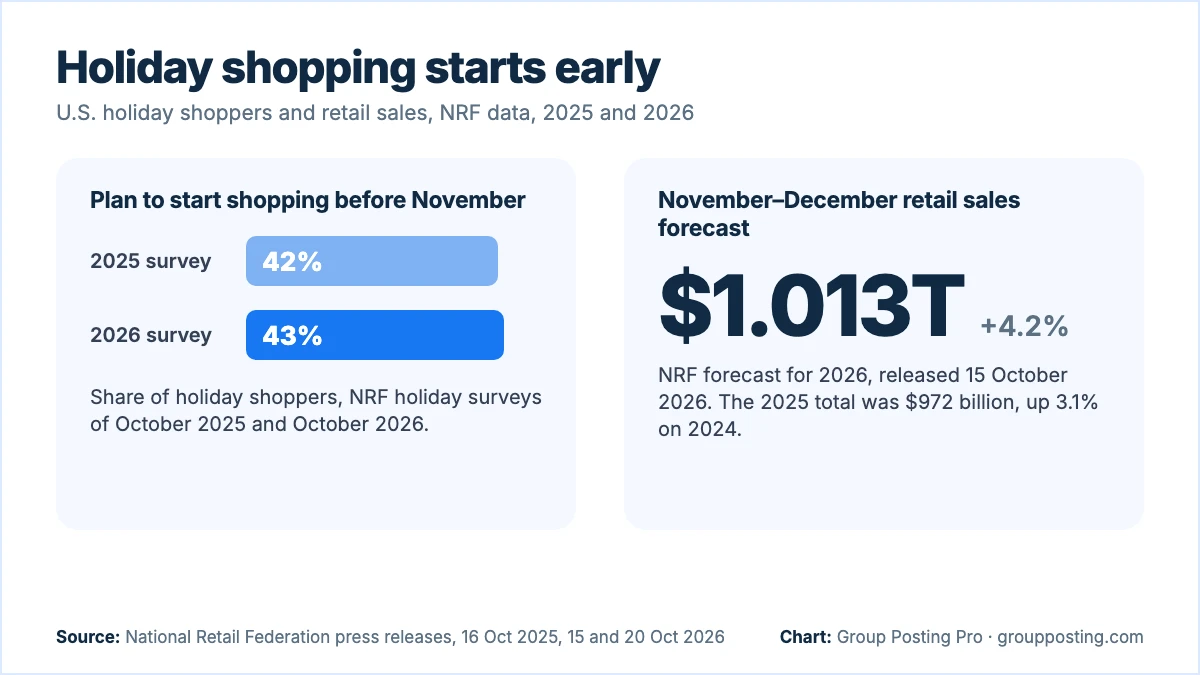
The timing is real, not a guess. The National Retail Federation (NRF) forecasts $1.013 trillion in November–December 2026 sales, up 4.2%, and 43% of holiday shoppers say they will start before November. This guide turns that into a dated calendar, a weekly routine and a rules checklist. Sources were checked on 28 October 2026.
1. What the 2026 numbers say
Three facts shape the plan.
- The season is big and slightly larger than last year. NRF’s forecast, released on 15 October 2026, puts November–December retail sales at $1.013 trillion, up 4.2% on 2025’s $972 billion (NRF press release). NRF counts the whole of retail, so this is the size of the market, not a promise for any one business.
- Many people start early. NRF’s 2026 holiday survey says 43% of shoppers plan to start before November, against 42% in 2025 (NRF holiday data; 2025 survey). A group post on 3 November is not early.
- Online spending peaks on a few days. In 2025 Adobe Analytics counted $6.4 billion of U.S. online spending on Thanksgiving Day, $11.8 billion on Black Friday and $14.25 billion on Cyber Monday, and $44.2 billion over Cyber Week as a whole (Talk Business, reporting Adobe Analytics; Adobe release).
The pattern matters more than any single number: demand arrives in a short peak, preceded by weeks of browsing. A group post cannot create that demand, but it can put your offer in front of people while they are still choosing. For how Facebook groups compare with other places to be found, see Facebook groups vs Reddit, LinkedIn, Discord, WhatsApp and Nextdoor.
2. The 2026 calendar
Thanksgiving is on Thursday 26 November, so the key U.S. dates fall like this: Black Friday on 27 November, Small Business Saturday on 28 November (always the Saturday after Thanksgiving, per Wikipedia), Cyber Monday on 30 November and GivingTuesday on 1 December (GivingTuesday). Christmas Day is Friday 25 December. Outside the U.S., swap in your own dates, such as 11 November for Singles’ Day or 26 December for Boxing Day.
Scroll diagram horizontally →
3. Rules first, because promotion is where groups get strict
Holiday posts are promotional by nature, and promotion is where groups are strictest. Before you plan any post, build your list.
- Sort your groups into three piles. Groups that allow business posts, groups that allow them on set days or in a thread, and groups that do not allow them at all. Only the first two belong in your plan.
- Write the rule next to each group. One line, such as “promo thread Fridays” or “no links in posts”. Our guide to Facebook group rules explains the three layers of permission, and the free group post checklist covers the check before each post.
- Plan for approval queues. Many groups review posts before they appear. A post you send on Thursday morning may not be live until Friday.
- Respect Facebook’s own limits. If you post to many groups, read Facebook group posting limits explained and what causes posting restrictions before you raise your volume.
A simple rule of thumb for this plan: one promotional post per group per week, and never the same wording twice. It is our suggested default, not a Facebook rule. Posting the same text in many groups is a common reason for duplicate-content flags, which how to avoid duplicate post flags explains.
4. The 9-week plan
| Week | Phase | Goal | What to post |
|---|---|---|---|
| 1 · 2–8 Nov | Prepare | List, rules, assets | No promotion yet. Join discussions in your groups and note each group’s rules. |
| 2 · 9–15 Nov | Prepare | Be useful first | A gift guide or checklist with no hard sell. Ask members what they are shopping for. |
| 3 · 16–22 Nov | Announce | Tell people what is coming | “Our deal starts Thursday” posts with the dates, and an early-access option for group members where rules allow. |
| 4 · 23–29 Nov | Peak | Convert interest | Offer posts on Thanksgiving week days that suit the group; a Small Business Saturday post on 28 November. |
| 5 · 30 Nov–6 Dec | Peak | Last chance, then thanks | A Cyber Monday reminder; a GivingTuesday post if you support a cause; a thank-you to early buyers. |
| 6 · 7–13 Dec | Deadlines | Gift-ready proof | Order-by dates, delivery times and real customer photos you have permission to share. |
| 7 · 14–20 Dec | Deadlines | Cut-off reminders | “Last day for delivery before Christmas” posts. Switch to digital or local pick-up options. |
| 8 · 21–27 Dec | Wrap-up | Last-minute gifts | Gift cards, vouchers, services and digital products. Pause on 24–25 December unless your audience is active. |
| 9 · 28 Dec–3 Jan | Wrap-up | Learn and reset | A thank-you post, a New Year offer if it fits, and a review of which groups worked. |
With 20 groups and one promotional post per group per week, the plan is about 20 group-posts a week from week 3 onward, roughly 140 across weeks 3–9. Weeks 1 and 2 are mostly reading and helping, which is why they come first.
5. Post types that fit each phase
Prepare: useful posts. A gift guide for the group’s topic, a “what to check before you buy” list, or a question. The goal is to be known as someone who helps before you ask for anything. Our guide to writing Facebook group posts covers structure and tone.
Announce: dates and reasons. State exactly what the offer is, when it starts, when it ends and how to claim it. Do not invent urgency. If a deal really ends on Monday, say Monday. Vague “limited time” wording is easy to spot and does not help a member decide.
Peak: one clear offer per post. One photo, one offer, one link or instruction. Our image size cheat sheet lists the shapes that fit the feed, and the best time to post guide helps you pick hours.
Deadlines: practical answers. People shopping in December want to know whether it will arrive. Put order-by dates, delivery areas and return rules in the post itself.
Wrap-up: thanks and next steps. Thank buyers, share a short result, and offer gift cards or services for the last days. The December routine is also a good time to review what you learned for January.
6. Where ads fit
Groups give you free reach, but nobody can tell you how much. Paid ads cost more in the holidays: agency benchmarks suggest Meta ad prices rise by roughly 25–60% in the fourth quarter, with the sharpest rise around Black Friday and Cyber Monday (Top Growth Marketing). These are third-party figures that name no data source, so treat them as direction, not a quote. If you do run ads, plan the budget from your target cost per lead with our Facebook ads budget guide, and see Facebook groups vs paid ads for how the two work together.
7. The weekly routine
- Monday: plan. Pick this week’s offer, write one core post and check each group’s rules for the week.
- Tuesday–Thursday: post. Send each group its own version at the time that suits it. Reply to comments the same day.
- Friday: follow up. Answer questions, thank people and note which groups produced replies.
- Weekend: review. Count replies and sales by group, drop the weakest groups and carry the best forward.
If you post to many groups, Group Posting lets you write a post once, choose your groups, and send it to one group at a time from your own Chrome with paced delays between groups. Plus and Pro plans add scheduling, so a Monday plan can be queued for the week. Pro also adds AI variations, which vary the wording for each group while keeping your offer and link unchanged, and campaigns for multi-week sequences like this one. You still read the rules, and you still own what you send. The free content calendar planner can help you lay the weeks out first.
8. What to measure
Keep a simple sheet with one row per group per week: post date, approved or declined, comments, messages, sales. Add a tracking tag to each link so you know which group sent a visitor; the free UTM builder and our guide to tracking social media leads with UTM parameters show how. Three ratios are worth watching: approved posts as a share of sent posts, comments per post, and sales per group.
Do not judge a group by reach alone. A small group with the right buyers often beats a large one. If a group removes a post or warns you, stop posting there until you have read the rule again.
Frequently asked questions
When should I start holiday marketing in Facebook groups?
Start in early November. NRF’s 2026 survey says 43% of holiday shoppers plan to begin before November, so waiting for Black Friday means missing the early browsing weeks. Spend the first two weeks being useful and checking rules, then announce your offers.
How often can I post in the same Facebook group?
Follow each group’s rules first. As a conservative default, post one promotional message per group per week and change the wording each time. Many groups restrict promotion to set days or threads.
Is Black Friday worth it for a small business in Facebook groups?
It can be, if the group allows promotion and your offer is real. Adobe counted $11.8 billion of U.S. online spending on Black Friday 2025, but a share of that spending goes to large retailers. Small Business Saturday on 28 November is a natural moment for local businesses.
What should I post in groups that ban promotion?
Be useful: answer questions, share a gift guide for the topic and reply when someone asks for a recommendation. Do not post offers. If a member asks for a recommendation, answer within the rules and say that you own the business.
Do I need ads as well as group posts?
No. Groups and ads do different jobs. Group posts cost time, and ads cost money that is likely to rise in the fourth quarter. Start with the groups you already belong to and add ads only if you have a target cost per lead.
Sources
- NRF: 2026 holiday sales forecast, 15 October 2026, checked 28 October 2026.
- NRF: winter holiday data and trends, checked 28 October 2026.
- NRF: 2025 holiday survey, 16 October 2025.
- Talk Business & Politics: Adobe Analytics, online holiday sales grew 6.8% to $257.8 billion, 9 January 2026.
- Adobe: 2025 holiday shopping season, January 2026.
- GivingTuesday, 1 December 2026, checked 28 October 2026.
- Wikipedia: Small Business Saturday.
- Top Growth Marketing: Facebook and Instagram CPM benchmarks, third-party estimates.
Explore the complete guide: Facebook group marketing.
For the group-publishing part of your workflow, explore campaigns and scheduled posting, or compare plans on Group Posting pricing.